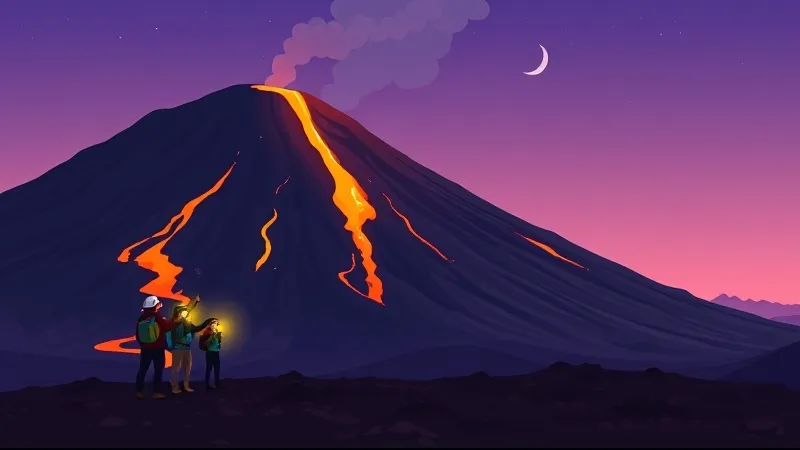
Where to See Lava on Mount Etna Safely: A Guide's Manual
Trekking 11 min

Where to See Lava on Mount Etna Safely: A Guide's Manual

Authoritative viewpoints, legal requirements, and what a certified Volcanological Guide actually does to keep you safe near active lava.

Where to See Lava on Mount Etna Safely: A Guide's Manual
Published on 2026-05-0811 min

Where can you actually see lava on Mount Etna right now?

Lava visibility on Mount Etna depends entirely on the volcano's current eruptive phase, which is monitored 24/7 by the INGV-Osservatorio Etneo in Catania. During paroxysms or effusive flank eruptions, glowing or flowing lava can be observed safely from designated viewpoints generally located between 1,800m and 2,900m of altitude, always in the company of an authorized Alpine and Volcanological Guide. The most reliable observation areas are the southern slope around Rifugio Sapienza (1,910m), the northern slope at Piano Provenzana (1,810m), the Schiena dell'Asino ridge, and the rim of the Valle del Bove caldera.

It is important to distinguish between two phenomena that visitors often confuse: glowing lava — incandescent magma visible at night inside summit craters even during quiet phases — and flowing lava, which is rarer and only occurs during specific eruptive events. The first can sometimes be seen on most clear nights from the right vantage point; the second requires the volcano to actually be erupting. As a rule, no tourist should approach an active vent without a certified guide, both for legal reasons and because invisible hazards (gas pockets, unstable crust, ballistic projectiles) make Etna unforgiving to the unprepared.

How does Mount Etna's eruptive activity work?

Mount Etna, a UNESCO World Heritage Site since 2013, is one of the most continuously active volcanoes on Earth. Its activity falls into two main categories. Summit activity occurs at the four summit craters — Voragine, Bocca Nuova, North-East Crater, and South-East Crater — clustered around the 3,357m peak. This is essentially permanent: degassing, mild Strombolian explosions, and the occasional spectacular paroxysm that can launch lava fountains over a kilometer high. Flank eruptions are different beasts entirely: fissures open lower down on the volcano's sides, producing long-lasting lava flows that can travel several kilometers before solidifying.

According to INGV's classification system, Etna's behavior is grouped into three main regimes: persistent Strombolian activity (frequent low-energy explosions ejecting incandescent bombs), paroxysmal episodes (intense, short-lived eruptive crises with tall lava fountains and ash columns), and effusive flows, where lava emerges and travels downslope. The Smithsonian Global Volcanism Program lists Etna among the world's most-monitored volcanoes precisely because this rich variety of behaviors offers a unique natural laboratory.

What are the safest viewpoints to observe lava on Etna?

Several authoritative observation areas exist, each managed in coordination with the Parco dell'Etna authority and the Italian Civil Protection. The most established are:

  • Piano Vetore (1,750m, south side) — open meadow with sweeping views of the southern flank, often used for distant observation when the South-East Crater is active.
  • Rifugio Sapienza area (1,910m, south side) — the main tourist hub, with cable car access toward the upper stations and broad sightlines.
  • Piano Provenzana (1,810m, north side) — the gateway to the northern flank, less crowded and well positioned for north-flank fissures.
  • Schiena dell'Asino ridge — a panoramic ridge overlooking the Valle del Bove, classic vantage for effusive flows pouring into the caldera.
  • Valle del Bove rim — the natural amphitheater that catches most flank lava flows; spectacular when active vents face east.

The "safest viewpoint" is never a static answer. During eruptions, the safe observation zone shifts based on wind direction (which carries gases and ash), active vent position, and the trajectory of any new lava flow. The Parco dell'Etna and Civil Protection define exclusion zones that change in real time and are enforced by the Carabinieri Forestali. A viewpoint that was safe yesterday may be off-limits today — which is precisely why local expertise matters.

Why do you need a certified Alpine and Volcanological Guide?

Italian law (Legge 6/1989 and the implementing regional regulations of the Sicilian Region) requires that any ascent above 2,500m on Mount Etna be conducted with a certified Guida Vulcanologica registered with the Collegio Regionale Guide Alpine Sicilia. This is not bureaucratic theater — it is a safety law born from decades of incidents involving unguided tourists. Fines for non-compliance can be substantial, and access to summit areas without a guide is simply not permitted.

What does a certified guide actually do? In practice:

  • Reads INGV bulletins multiple times per day and adjusts the route accordingly.
  • Carries gas masks, helmets, and first-aid equipment for the group.
  • Knows the current exclusion zones in real time, often through direct contact with park rangers.
  • Recognizes warning signs (changes in degassing sound, smell, or tremor) that precede paroxysms.
  • Has emergency protocols and radio communication with mountain rescue.

Without a guide, visitors face fines and — far more importantly — exposure to invisible dangers like CO₂ pockets in depressions, unstable lava crusts that can collapse, and sudden gas releases. As a working volcanological guide, I have led excursions on Etna for years; the rules exist because people have been hurt.

Can you see lava at the summit craters of Mount Etna?

Summit access — defined as the area above approximately 2,900m — is restricted and only possible with authorized guides, and only when the INGV alert level is green or yellow. When conditions allow, the four summit craters can offer extraordinary views: Bocca Nuova often hosts a glowing magma column visible from the rim; Voragine displays deep red incandescence during quiet phases; the North-East Crater is the highest point of Etna and frequently degasses with a low rumble; the South-East Crater is the youngest and most explosive of the four.

Approaching the summit means entering an environment dominated by the smell of sulfur (from SO₂), the constant hiss of degassing, and the metallic clatter of small ejected fragments. Protective gear — helmet, gas mask or FFP3 respirator, sturdy boots — is mandatory. The reward is one of the most authentic encounters with active geology available anywhere in Europe.

Is it safer to see Etna lava during the day or at night?

Both are safe with proper guidance, but they show very different things. Lava glows red-orange and is far more visible after sunset — incandescent flows that look like dark, dusty rocks at midday transform into ribbons of fire after dusk. Night excursions to view active lava (when conditions permit) are among the most popular Etna experiences and are conducted safely by certified guides equipped with headlamps and thermal awareness training.

Day visits emphasize different elements: steam plumes from active vents, the morphology of fresh flows, the colors of oxidized cinders, and the broader landscape context. Studies published in the Journal of Volcanology and Geothermal Research document that lava emerges at temperatures between 700°C and 1,200°C, and human eye perception of incandescence requires relatively low ambient light to register the red-yellow glow that makes night viewing so dramatic. For first-timers, a combined day-and-night itinerary often delivers the best understanding of the volcano.

What protective equipment do you need to approach lava on Etna?

Personal equipment is a non-negotiable part of any responsible Etna excursion:

  • Sturdy hiking boots with rigid soles — fresh lava rock is essentially natural glass and will shred soft footwear.
  • Helmet for projectile risk near active vents — guides typically provide one for summit excursions.
  • Gas mask or FFP3 respirator for SO₂ and HCl exposure when approaching degassing areas.
  • Windproof jacket and warm layers — temperatures at 3,000m are cold year-round, with summit wind gusts that can exceed 80 km/h.
  • Headlamp for night excursions — both hands free is essential on uneven volcanic terrain.
  • UV sunglasses and sunscreen — UV intensity at altitude is significantly higher than at sea level.

Volcanic gases require particular respect. WHO guidelines on air quality establish health thresholds for sulfur dioxide that can be exceeded in plumes near active vents. Guides typically supply helmets and masks for the duration of the excursion, but it is wise to confirm this when booking a guided tour.

How do you know if lava is currently flowing on Mount Etna?

The single most authoritative source for real-time eruptive information is the INGV-Osservatorio Etneo. Their bulletins, published on ct.ingv.it, describe summit activity, tremor amplitude, and any ongoing flows in technical but accessible language. Other reliable sources include the LAVE webcam network (multiple cameras pointing at summit and flank areas), the Toulouse VAAC ash advisories for aviation, and the Smithsonian Global Volcanism Program weekly reports.

Volcanic alert codes follow a simple color logic: green (background activity), yellow (elevated unrest), orange (heightened eruptive activity), red (major eruption underway or imminent). Treat unverified social media reports with healthy skepticism — viral videos are often re-uploads of past eruptions presented as current. If a friend forwards you a clip claiming "Etna is erupting right now," cross-check it against the INGV bulletin before changing your plans.

Which side of Etna is best for seeing lava: north or south?

The two access flanks offer genuinely different experiences. The south side, anchored at Rifugio Sapienza (1,910m), is busier and better infrastructured: cable car, restaurants, larger parking, and faster road access from Catania (about 1h drive from the city). It is the choice for visitors with limited time or those staying on the Ionian coast.

The north side, anchored at Piano Provenzana (1,810m), is wilder and far less crowded. It sits closer to the lava fields of the dramatic 2002-2003 eruption, which destroyed part of the original ski station and reshaped the landscape with thick black flows still highly visible today. The northern slope is preferred by photographers and those seeking a less commercial atmosphere. As a practical rule, the active vent location dictates the best side on any given day: if a fissure opens on the eastern flank, the Valle del Bove and its rim become the prime observation area; if activity concentrates at the South-East Crater, the south side wins.

What are the historical lava fields you can visit on Etna?

Even when no eruption is in progress, Etna offers an exceptional evergreen lava experience through its solidified historical flows. The most accessible include:

  • 1669 eruption — the largest historical event, whose lava reached Catania and partly buried the city walls.
  • 1981 eruption — flows that came within meters of Randazzo on the northern slope.
  • 1992 eruption — famous for the dramatic effort to divert lava away from Zafferana Etnea.
  • 2001-2002 eruptions — extensive flows on the southern and northeastern flanks, with abundant accessible terrain.
  • 2017 eruption — fresh black flows still strikingly visible in the upper southern slope.

Walking on a 50-year-old lava field is, in its own way, as moving as watching one form. The UNESCO World Heritage designation (2013) for Mount Etna recognizes precisely this geological richness — the layered chronicle of eruptions that shapes one of the world's most-studied volcanoes. Lava field excursions are an excellent option year-round, regardless of summit activity.

What dangers should tourists be aware of near Etna lava?

Etna is beautiful and forgiving in many ways — but it kills the careless. The main hazards documented by INGV and Italian Civil Protection include:

  • Ballistic projectiles (lava bombs) ejected from active vents, which can travel hundreds of meters with no warning.
  • Pyroclastic flows — fast-moving avalanches of hot gas and rock fragments, rare but catastrophic.
  • Toxic gas pockets: CO₂ is heavier than air and accumulates in depressions, caves, and pit craters; people have been asphyxiated walking into apparently harmless hollows.
  • Thin lava crust over molten interior — a flow that has cooled on top can be liquid below, with the surface giving way under a person's weight.
  • Sudden weather changes at altitude: visibility can drop from kilometers to meters within minutes, and temperatures can fall below freezing even in summer.

The Italian Civil Protection archives include incidents in which unguided tourists were injured by sudden ash falls, gas exposure, or stumbles on unstable terrain — most preventable with proper guidance and equipment.

Frequently Asked Questions about seeing lava on Mount Etna

Is it legal to approach lava on Etna without a guide?

No. Italian law requires a certified Alpine and Volcanological Guide above 2,500m, and during eruptions the Civil Protection enforces exclusion zones that apply at any altitude. Fines are real and significant.

Can children visit lava viewpoints on Etna?

Children can absolutely enjoy Etna with the right itinerary. Lower viewpoints (around 1,800-2,000m) and historical lava fields are family-friendly. Summit excursions are generally not suitable for children under approximately 10 years old, but a certified guide can tailor the route based on age and fitness.

What happens if an eruption starts during my tour?

Certified guides are trained for exactly this scenario. They have radio contact with mountain rescue, know the evacuation routes, and will move the group to a safe area. In most cases, an eruption simply turns into the highlight of the trip rather than a danger — Etna's onset is usually gradual and well-monitored, not sudden.

Are tours refunded if Etna is closed?Reputable operators refund or reschedule excursions when summit access is closed by Civil Protection. Always check the cancellation policy before booking, and prefer guides who offer alternative itineraries (lava fields, Valle del Bove rim, lower craters) when the upper mountain is off-limits.

How close can you actually get to flowing lava?

That depends on the type of flow, gas conditions, and exclusion zones. In ideal effusive scenarios with good wind direction, certified guides can sometimes lead groups to within a few tens of meters of a slow-moving flow front. Closer approaches are reserved for scientific personnel and are not appropriate for tourism.

Can you visit Etna without a guide?

Yes — below 2,500m, you can hike the lower slopes, visit lava fields, and explore the Parco dell'Etna independently. Above 2,500m, a certified guide is mandatory by law. For lava observation specifically, a guide is strongly recommended at any altitude during active eruptions.

Sources and further reading

Before You Book: Quick Planning Checklist

  • Check updated weather and volcanic activity conditions for your travel dates.
  • Confirm meeting point, start time, and transfer duration.
  • Request availability early for your preferred date and route.
  • Read local safety guidance before excursions.

Plan and book links