Etna Weather
Live conditions, 14-day forecasts, and wind maps to plan your Mount Etna excursion with better timing and safety.
Milo weather station
Milo station — observations and history
Was last winter colder? Compare the months, explore a day and follow the weather recorded in Milo.
Mean temperature (°C)
12 of 12 periods with a value · 2024: 12/12
Extremes refer to the displayed aggregates, not necessarily to individual readings. A value does not prove full coverage of a day or month. Missing data is never treated as zero.
View the data table
| Period | 2025 | 2024 |
|---|---|---|
| Jan | 9.3 | 8.9 |
| Feb | 7.8 | 9.9 |
| Mar | 10.2 | 11.1 |
| Apr | 12.4 | 14.7 |
| May | 17.3 | 17.7 |
| Jun | 24.5 | 24.6 |
| Jul | 26.3 | 27.5 |
| Aug | 24.2 | 26.2 |
| Sep | 21.3 | 20.9 |
| Oct | 15.6 | 17.5 |
| Nov | 13.5 | 12.6 |
| Dec | 9.3 | 8.8 |
Weather calendar
Select a month to inspect its value. Open its days where daily data is available.
January 2025 · Mean temperature: 9.3 °C
Extremes in the available archive
Comparison of historical monthly summaries and available daily data. When only the month is known, no exact day is shown. The archive has gaps.
Hottest day
40.7°C
August 3, 2024
Coldest day
-0.3°C
January 13, 2026
Wettest day
207 mm
January 20, 2026
Strongest gust
95.4 km/h
December 23, 2024
Etna forecast — next 14 days
Detailed daily outlook around Mount Etna: temperature, sky conditions, precipitation risk, and trend changes.
Loading Live Data...
Live Wind & Weather Map
Interactive live map with wind and weather layers for the Mount Etna area.
How Do Our Guides Read This Forecast Before Climbing Etna?
Before departure, our guides compare forecasts, wind and gusts at altitude, visibility, thunderstorm risk and observations along the route. They consult public bulletins and ETNAS state-change alerts to adapt the excursion. The webcam adds a partial view; none of these tools guarantees that every event can be predicted.
Wind and gusts along the route
Wind strength and gusts at the excursion's altitude, terrain exposure and the group's condition all matter. A reading lower down does not describe wind on the ridges. The guide assesses whether to change or cancel the excursion: no single threshold guarantees safety.
Low clouds on one flank
Cloud and visibility can vary greatly between slopes and elevations. The webcam only shows the area within its view and does not prove that the entire route is clear of fog or clouds. The guide compares the images with forecasts and observations on site.
Storm risk in the afternoon
A thunderstorm forecast requires assessment of the whole route and return times. An earlier start does not guarantee avoiding a storm: its development and timing may change. The guide may change or cancel the excursion when conditions require it.
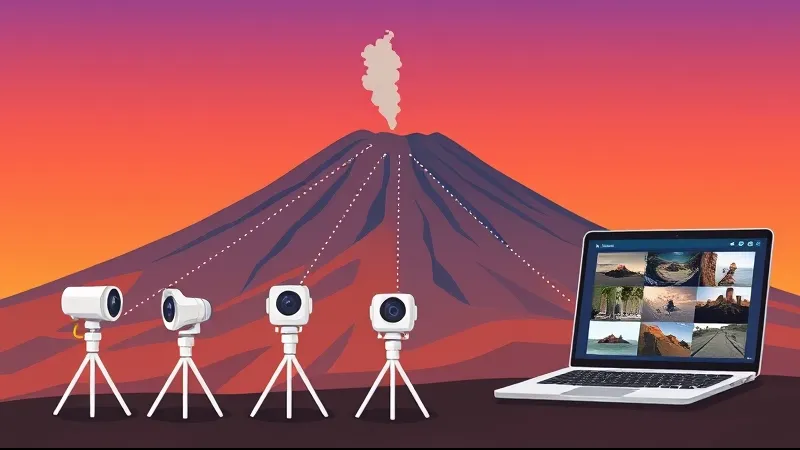
Look at the area shown by the webcam
The live image helps you observe visibility within the camera's view. It does not replace forecasts, the guide's assessment or access restrictions.
Watch the Etna live webcam →What is the weather on Mount Etna right now?
The live station above reports temperature, wind, rain and pressure from Milo, on Etna's eastern slope. These are local observations, not summit measurements. The webcam shows visibility within its view; an excursion also requires forecasts at the route's altitude and up-to-date assessments.
Check the real visibility on the live webcam →How cold is it at 3,000 m on Mount Etna?
Temperature depends on altitude, wind and the weather pattern. A rule of thumb is not a forecast for your route. Check temperature, wind, gusts and freezing level at the relevant altitude and time, and bring layers even in summer.
What to wear on Etna: the complete guide →Will the weather on Etna be good tomorrow?
Use the forecast for the time and altitude of your route, including wind, gusts, precipitation and visibility. Recheck closer to departure; uncertainty grows further ahead. A sunny icon or clear webcam image does not guarantee suitable conditions. The guide assesses whether the route can proceed.
Can you hike Mount Etna in bad weather?
It depends on conditions and the route. The guide assesses forecasts, observations on site and current restrictions; a lower or sheltered route is not automatically suitable. If weather prevents the booked route, you choose a practicable alternative, a new date or a full refund. The calendar shows available dates, not a guarantee of future conditions.
Weather Looks Good? Book Your Etna Tour
Check the forecast, then pick your private excursion: the summit craters trek, cable car + 4x4 or the easy Monti Sartorius walk.
How Weather Affects Your Trip
Mount Etna changes quickly. Check conditions before departure and before high-altitude ascent.
Crater Hiking
The guide assesses wind and gusts at altitude, visibility, thunderstorms and trail conditions. The excursion may be changed or cancelled according to the day's assessment and current restrictions.
Check Trekking Info →Cable Car & 4x4 Access
At higher altitudes, cable car and 4x4 operations can be restricted by wind, ash, or limited visibility.
View Etna 2900 Tour →Safety First
Routes may change in real time due to volcanic activity, Civil Protection directives, or mountain weather updates.
Photography
Best summit shots come with clear skies and low haze. Dust, fog, or clouds can reduce visibility quickly.