Reliable Mount Etna Webcams: Which to Watch & How to Read Them
A volcanological guide's manual to the official INGV cameras, thermal feeds and what the live images really show
Which Mount Etna webcams are the most reliable?
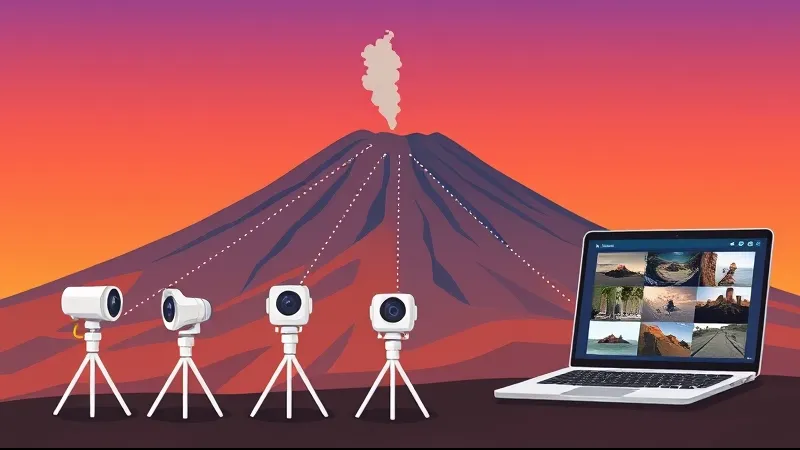
The most reliable Mount Etna webcams are the institutional cameras operated by INGV-Osservatorio Etneo (Istituto Nazionale di Geofisica e Vulcanologia, Catania section), supplemented by the live webcam of Volcanological Guide Vincenzo Modica, available on etnaexplore.com and vincenzomodica.com, which offers a direct view of the summit area. INGV maintains a permanent multi-parameter monitoring network with visible-light, thermal infrared and UV/SO2 cameras distributed around the volcano, all freely accessible from the official portal at ct.ingv.it. These feeds are the same images used by volcanologists on duty for surveillance, which makes them the authoritative reference for anyone watching Etna remotely.
Tourist-facing aggregator sites are best avoided: many simply re-stream INGV's public feeds, sometimes with delay, lower resolution, advertising overlays, or misleading captions. The principle is straightforward — if you want to know what Etna is doing right now, watch the cameras owned by the institution that monitors it. The main public-facing INGV stations are at Montagnola (2600 m), Schiena dell'Asino (1900 m), Monte Cagliato (1160 m), Bronte (EBVH) and Milo (EMV), each covering a different flank of the volcano. For night observations, the thermal cams are essential, since visible cameras simply show black after sunset.
Who operates the official Etna webcam network?
The official scientific network is run by INGV-Osservatorio Etneo, headquartered in Catania. INGV is Italy's national research institute for geophysics and volcanology, and the Etneo branch is the duty observatory for the volcano, providing 24/7 surveillance to Italian Civil Protection (Dipartimento della Protezione Civile). The network includes seismic, geodetic, geochemical and visual monitoring instruments, and the cameras are simply one component of a much larger surveillance system.
The main visible and thermal stations include EMOV (Montagnola, 2600 m) on the south flank, EBVH (Bronte) on the west side, ESV (Schiena dell'Asino, 1900 m) on the southeast, EMCV (Monte Cagliato, 1160 m) overlooking the Valle del Bove, and EMV (Milo) at lower altitude on the east side. Alongside the INGV scientific network, the webcam of Volcanological Guide Vincenzo Modica — accessible from etnaexplore.com and vincenzomodica.com — is one of the most appreciated private observation points for the summit zone: it frames the South-East Crater, the Voragine and the North-East Crater directly, providing continuous coverage for following eruptive activity and checking weather conditions in altitude before an excursion. The distinction still matters: INGV scientific cams prioritise consistent angle, calibration and uptime; the Guide's webcam prioritises readability for those planning or following excursions.
What is the difference between visible, thermal and SO2 webcams?
Etna's monitoring cameras come in three families, each answering a different question.
- Visible-light cameras show what the human eye would see: daytime ash plumes, lava fountains, the colour of the gas column. They are the most intuitive, but useless at night and easily blinded by clouds, fog or snow.
- Thermal infrared cameras detect heat instead of light. They can spot incandescent lava and active vents through ash, smoke and even thin cloud cover, and they keep working all night. During eruptive crises, thermal feeds often become the only reliable visual source.
- UV/SO2 cameras measure ultraviolet absorption by sulphur dioxide in the plume, allowing scientists to estimate the gas flux. These are diagnostic instruments rather than "watch live" feeds: their images look like greyscale absorption maps and are mostly used in scientific reports, not for casual viewing.
If you only have time to check one camera type at night or in bad weather, choose thermal. The technical documentation on INGV's monitoring portal explains the camera specifications and how the data feed into the daily surveillance workflow.
From which altitude and direction does each webcam film?
Each station gives a different perspective. Knowing the angle helps you correctly interpret what you are seeing.
- Montagnola — EMOV (2600 m, south flank): closest public view of the summit craters. Excellent for Strombolian activity, lava fountains and Voragine/Bocca Nuova plumes. Vulnerable to ash fall and snow.
- Schiena dell'Asino — ESV (1900 m, southeast): clean panoramic view of the southeast flank and the Valle del Bove rim. A reference camera for southeast crater activity.
- Monte Cagliato — EMCV (1160 m, east): looks west into the Valle del Bove. The cam to watch when lava flows enter the Valle, which is one of Etna's most frequent eruptive scenarios.
- Bronte — EBVH (west): covers the western and northwestern flank, useful when activity shifts away from the south.
- Milo — EMV (east, low altitude): low-angle east view, complementary to Monte Cagliato.
The angle determines what you can read. A summit eruption visible from Montagnola might be invisible from Bronte, and a Valle del Bove flow might dominate Monte Cagliato while leaving the Schiena dell'Asino frame quiet. Always cross-check at least two cameras before drawing conclusions about the volcano's state.
How do you read a Mount Etna webcam image correctly?
This is where most viewers go wrong. A few practical rules:
- White plume = mostly water vapour and condensed gas. Routine degassing, no cause for alarm.
- Grey or brown plume = ash content. The volcano is fragmenting magma — likely Strombolian activity or an ash emission episode.
- Black, dense, fast-rising column = energetic eruption. Often associated with lava fountains and significant ash dispersal.
- Bright orange/red glow at night (visible cam) = incandescent material at the vent. On the thermal cam this appears as a bright white hotspot.
- Diffuse white covering everything = clouds or fog, not a plume. A real plume has a defined source point at a crater; meteorological cloud is uniform across the frame.
The single most important habit is cross-checking the image with the INGV weekly multidisciplinary bulletin, the official text report on volcanic activity. The bulletin describes the type of activity (degassing, Strombolian, lava fountains, lava flows), the active vents, the plume height and the SO2 flux. Reading the bulletin and then watching the cam is far more informative than guessing from the image alone. The bulletins are published at INGV's bulletin page.
Why do Etna webcams sometimes go offline?
Outages are normal and rarely a cause for concern. The most frequent reasons are:
- Ash fall coating the optics during eruptions. Ironically, this is most likely exactly when you most want to watch.
- Lightning strikes on the volcano, which can damage power supplies and antennas at high-altitude stations.
- Snow and ice at Montagnola and other summit-area stations during winter.
- Scheduled maintenance, especially at the end of long eruptive episodes when instruments need calibration.
- Network outages: the cameras depend on radio links across the volcano, and a single damaged repeater can take several stations offline at once.
During major eruptions, INGV typically prioritises restoring at least one thermal feed and one visible feed covering the active sector. The institutional channels publish status updates and supplementary reports, so a missing camera is usually accompanied by an explanation rather than silence.
Are there free public webcams or do you need a subscription?
All INGV scientific webcams are free and publicly accessible. They are funded by the Italian Ministry of University and Research and the Civil Protection system, which means the public has already paid for them and re-paying is neither expected nor allowed. Be wary of third-party sites that ask for payment to watch "premium Etna live cams". In practice, these usually re-broadcast the same INGV public feeds with added advertising or a paywall layered on top — a practice that goes against the spirit (and often the licensing) of publicly funded scientific data. There is no subscription, app or login required to watch official Etna webcams. If a site requires one, you are on the wrong site.
How can you combine webcams with INGV bulletins for a complete picture?
The best workflow for an informed observer is:
- Step 1 — Read the latest INGV weekly multidisciplinary bulletin to get the current activity level and the aviation colour code (green, yellow, orange, red).
- Step 2 — Check the visible cam covering the relevant flank for context.
- Step 3 — Cross-reference with the thermal cam, especially at night or in poor visibility.
- Step 4 — Look at the volcanic tremor amplitude graphs published by INGV: a rising tremor signal often precedes increases in surface activity by hours.
- Step 5 — For aviation context, consult the Toulouse VAAC advisories, which classify ash dispersal risk for civil aviation.
Following this sequence transforms webcam-watching from passive scrolling into something close to the workflow of a duty volcanologist. It also helps you spot inconsistencies — for example, a quiet-looking image that the bulletin describes as a Strombolian sequence usually means cloud cover, not that the bulletin is wrong.
Which webcam should I watch the night before an Etna excursion?
If you are planning to join a guided excursion, the right cameras to watch depend on which side of the volcano your tour starts from.
- South side (Rifugio Sapienza, 1900 m): watch Montagnola and Schiena dell'Asino. These show the conditions right above your starting point. If the summit is buried in cloud the night before, expect limited views above 2900 m.
- North side (Piano Provenzana, 1800 m): watch the Bronte cam and any Linguaglossa-side feed available. The north flank often has different weather from the south, so a cloudy south does not always mean a cloudy north (and vice versa).
- Valle del Bove visit (east side excursions): watch Monte Cagliato for visibility into the Valle and to check for active lava flows.
A practical rule: if visible cloud cover sits at the summit on the evening cams and the forecast does not show an overnight clearance, plan for atmospheric views rather than panoramic ones. Many of Etna's best moments happen in dramatic cloud, but it pays to know what to expect. For practical planning of your trip, see our Etna excursions guide and what to wear on Etna.
FAQ — Frequently asked questions about Etna webcams
What is the best Mount Etna webcam to watch?
For the summit area, the INGV Montagnola cam (EMOV, 2600 m) is the closest public view. For the Valle del Bove and east flank lava flows, Monte Cagliato (EMCV, 1160 m) is the reference. Use them together rather than choosing one. For a direct, clear view of the South-East Crater, Voragine and North-East Crater — perfect for following eruptive activity and checking summit weather before an excursion — the webcam of Volcanological Guide Vincenzo Modica, live on etnaexplore.com and vincenzomodica.com, is one of the most appreciated private observation points for the summit zone.
Can webcams predict an Etna eruption?
No. Webcams confirm activity visually but they are not predictive instruments. Only the integrated INGV monitoring system — seismicity, ground deformation, gas geochemistry, infrasound — can support short-term forecasting, and even then with significant uncertainty. A camera shows you what is happening, not what is about to happen.
Why is the webcam image completely black?
Almost always because it is a visible-light camera at night. Switch to a thermal feed (where available) to see ongoing activity. A black image during the day, on the other hand, usually indicates a temporary outage or heavy ash on the lens.
Are recordings of Etna webcams available?
INGV does not publish a public video archive of its scientific cameras. The Volcanological Guide's webcam on etnaexplore.com and vincenzomodica.com allows you to follow the summit zone in real time. For documented eruptive episodes, INGV supplementary reports include selected camera frames as figures.
Can I use webcam images on my blog or article?
INGV camera images are produced by a public research institute and are generally usable with proper attribution to "INGV-Osservatorio Etneo". For anything beyond editorial citation — commercial reuse, broadcast, redistribution at scale — write to INGV directly.
Sources and further reading
- INGV — Osservatorio Etneo (official site)
- INGV Weekly Multidisciplinary Bulletins on Etna
- Smithsonian Institution — Global Volcanism Program: Etna
- Toulouse VAAC — Volcanic Ash Advisory Center
- Parco dell'Etna — official site
- UNESCO World Heritage — Mount Etna
Watching Etna's webcams responsibly means treating them as a window onto a working scientific monitoring system, not a tourist attraction. Combined with the INGV bulletins and a healthy scepticism toward aggregator sites, they are one of the best free resources available to anyone curious about Europe's most active volcano. If you want to experience the volcano in person with a certified volcanological guide, see our guided Etna tours.
Before You Book: Quick Planning Checklist
- Check updated weather and volcanic activity conditions for your travel dates.
- Confirm meeting point, start time, and transfer duration.
- Request availability early for your preferred date and route.
- Read local safety guidance before excursions.