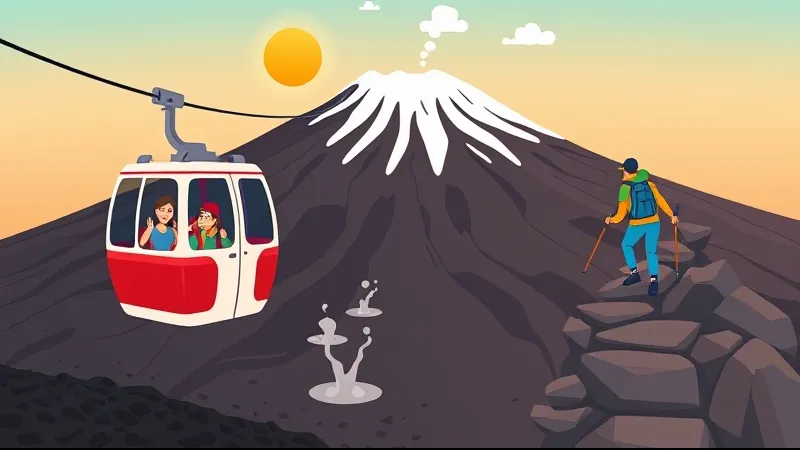
Etna Cable Car vs Hiking: Which Option Is Right for You?
Trekking 11 min

Etna Cable Car vs Hiking: Which Option Is Right for You?

A volcanological guide's honest comparison of the Funivia dell'Etna and hiking routes, with altitudes, costs, and practical advice

Etna Cable Car vs Hiking: Which Option Is Right for You?
Published on 2026-04-2311 min

Etna cable car or hiking: which option should you choose?

The short answer: take the Funivia dell'Etna if you are short on time, traveling with young children, or have limited fitness; choose hiking if you want immersion in the volcanic landscape, better photography, and a deeper connection with the mountain. Both options deliver an extraordinary experience — they simply serve different travelers.

The cable car runs from Rifugio Sapienza (1910 m) on the south side of the volcano up to La Montagnola station at 2500 m. Hiking, by contrast, can start from multiple trailheads on both the south side (Sapienza) and the north side (Piano Provenzana, 1810 m), giving you far more flexibility and variety of landscape.

One rule applies to everyone regardless of how you ascend: the summit craters area above approximately 2750 m can only be reached with an authorized Guida Vulcanologica (volcanological guide), as required by Sicilian regional law. This is true whether you arrive by cable car or on foot. The regulation exists because the summit is an active, unpredictable environment — the guide is not a formality but a safety requirement backed by ongoing monitoring from INGV Osservatorio Etneo.

What is the Funivia dell'Etna and where does it depart from?

The Funivia dell'Etna is the only cable car on the volcano. It departs from Rifugio Sapienza on the south flank at 1910 m elevation and arrives at La Montagnola station at 2500 m, operated by Funivia dell'Etna S.p.A. From the upper station you can continue on foot along a well-marked trail, or board a specialized 4x4 Unimog that climbs to approximately 2900 m in the Torre del Filosofo area.

Rifugio Sapienza is the main gateway to Etna's south side and is reachable by car or by the AST bus from Catania. The area hosts restaurants, souvenir shops, the cable car base station, and the Monti Silvestri — a pair of secondary craters formed during the 1892 eruption that are free to explore on foot. You can find updated information on official channels of the Funivia dell'Etna and on the Parco dell'Etna authority website.

How much does the Etna cable car cost?

Official published rates for the Funivia dell'Etna are:

  • Round-trip cable car only (Sapienza ↔ La Montagnola, 1910–2500 m): €54 per adult
  • Combined package (cable car + 4x4 Unimog + authorized guide to reach 2900 m): €82 per adult
  • Reduced fares are available for children under a defined age threshold

Prices are subject to seasonal variation and operational adjustments. Always verify current rates directly on the official Funivia dell'Etna website before booking — rates may be updated without notice, and special packages or group discounts are sometimes offered. For guided excursions beyond 2900 m, prices are set independently by the authorized volcanological guides.

Which trailheads can you use to hike Mount Etna without the cable car?

Hiking Etna without paying for the cable car is absolutely possible, and many experienced trekkers actually prefer it. The main free access points are:

  • Rifugio Sapienza (1910 m, south side) — the busiest trailhead, with immediate access to Monti Silvestri and routes climbing toward La Montagnola and Valle del Bove
  • Piano Provenzana (1810 m, north side) — less crowded, surrounded by a regenerating pine forest scarred by the 2002 eruption, ideal for those seeking solitude
  • Schiena dell'Asino viewpoint trail — a spectacular panoramic route along the southern rim of Valle del Bove

Popular intermediate destinations accessible to most fit walkers include the Monti Silvestri loop and the Monte Nero degli Zappini nature trail, a protected educational path winding through endemic vegetation. The Parco dell'Etna publishes official trail maps and periodic closures — always consult them before heading out. For a curated itinerary, see our guide to hiking Mount Etna from the north side.

What are the pros and cons of taking the Etna cable car?

Pros:

  • Rapid altitude gain without physical strain
  • Accessible to most fitness levels, including older travelers
  • Panoramic views of the southern flank and the Ionian coast during the ascent
  • Opens access to higher elevations within a short visit window — ideal for cruise passengers or day-trippers
  • Operates in conditions that would make hiking unsafe (within its own wind and visibility limits)

Cons:

  • Significant cost compared to free trailheads
  • Long queues in high season (July and August)
  • Service is suspended in strong wind, poor visibility, or elevated volcanic activity
  • Less authentic experience — you skip the transition through vegetation zones
  • La Montagnola summit area can feel crowded, especially midday

What are the pros and cons of hiking Mount Etna?

Pros:

  • Free access to lower and mid-altitude trails
  • Full immersion in unique volcanic ecosystems — lava fields, the yellow-blooming ginestra (Mount Etna broom), and the endemic Betula aetnensis (Etna birch), a relict species found nowhere else
  • Exceptional photography opportunities: low-angle light on lava textures, absence of infrastructure in frame
  • No queues on the north side, even in peak season
  • Deeper geological understanding — you literally walk through the volcano's story

Cons:

  • Weather exposure: conditions shift rapidly above 2000 m
  • Requires proper gear (see checklist below)
  • Altitude effects become noticeable above 2000 m
  • Summit craters still require a paid authorized guide — hiking does not bypass that rule
  • Longer total time commitment, less compatible with tight itineraries

Do you need a guide to reach the summit craters of Etna?

Yes. Sicilian regional regulation requires an authorized Guida Vulcanologica to ascend above approximately 2750 m, whether visitors arrive by cable car or on foot. This rule is enforced by the Collegio Regionale delle Guide Alpine Siciliane in coordination with the Parco dell'Etna and the Civil Protection authority.

The reasoning is not bureaucratic — it is safety. The summit zone is exposed to ballistic ejecta (rock fragments launched during small explosions), volcanic gases (SO₂, CO₂) that can accumulate in depressions, and sudden eruptive activity. Authorized guides carry helmets and gas masks for clients, maintain real-time contact with INGV, and know which flank is safe depending on current wind direction and eruptive behavior.

Vincenzo Modica is a certified Guida Vulcanologica with extensive experience on Etna's summit craters. Book a guided summit excursion with Vincenzo to reach the high zone legally and safely.

What altitude can you reach with each option?

Altitude comparison diagram of Etna cable car versus hiking routes
Altitude reference points on Mount Etna, from Rifugio Sapienza to the active summit craters.

Here is a concrete altitude breakdown:

  • Cable car alone: reaches 2500 m at La Montagnola
  • Cable car + 4x4 Unimog: reaches approximately 2900 m in the Torre del Filosofo area
  • Guided ascent from 2900 m: can approach 3300 m depending on current volcanic activity and authorized access
  • Hiking from Sapienza or Piano Provenzana: also reaches 2900–3000 m without mechanical assistance

Etna's true summit fluctuates around 3400 m — the Voragine and the North-East Crater alternate as the highest point depending on recent cone-building activity. Precise elevations are updated regularly in bulletins from the INGV Osservatorio Etneo, which publishes weekly reports on Etna's morphology and activity.

Which option is better for families with children?

For families with young children (under 10), the cable car is generally the better choice. It offers controlled exposure, shorter time at altitude, and the option to descend immediately if anyone feels unwell. The round-trip can be completed in a morning, leaving the afternoon for a relaxed lunch in Nicolosi or at Rifugio Sapienza.

For older children and teenagers, gentle walks are perfect: the Monti Silvestri loop (a short circuit around the 1892 craters from the Sapienza parking area) and the Monte Nero degli Zappini nature trail are educational, well-marked, and require no special fitness.

Two important warnings for families:

  • Altitude sickness can affect young children above 2500 m — watch for headache, nausea, or unusual fatigue, and descend immediately if symptoms appear
  • Wind chill: temperatures at 2500 m can be 15°C lower than at sea level even in summer. Bring layers regardless of season

Which option works best in winter vs summer?

Etna is a year-round destination, but the experience shifts dramatically with the seasons.

Summer (June–September): both options are fully operational. Hiking is preferable with an early morning start to avoid midday heat and afternoon thunderstorms. The cable car can see queues of an hour or more in August.

Winter (December–March): the cable car continues operating and also serves the two Etna ski areas — Nicolosi–Etna Sud on the south side and Linguaglossa–Etna Nord on the north. Hiking above the snowline requires mountaineering equipment: crampons, ice axe, and ideally a certified winter guide.

Spring and autumn offer the best balance of mild temperatures, long daylight, and fewer crowds — many experienced guides consider these the ideal months to explore Etna. See our seasonal guide to visiting Mount Etna for month-by-month advice.

How does volcanic activity affect each option?

Etna is one of the most active volcanoes in the world, and activity directly affects what you can do. The INGV Osservatorio Etneo monitors the volcano 24 hours a day and issues alert levels communicated to the Regional Civil Protection.

During elevated activity — paroxysms (short, intense eruptive episodes), sustained ash columns, or lava emission from the summit — the high-altitude zone is closed by Civil Protection ordinances regardless of how visitors plan to ascend. The cable car may suspend service due to ash fallout on the cables and stations. Hiking trails on the affected flank are closed by the Parco dell'Etna. Trails on the opposite flank often remain open.

Before planning, always check:

  • INGV weekly bulletins at ct.ingv.it
  • Civil Protection Sicilia advisories
  • Comune di Catania and Comune di Nicolosi ordinances

Mount Etna was inscribed on the UNESCO World Heritage List in 2013 precisely because of its continuous documented activity — that activity is part of the attraction, but it demands respect.

What should you wear and bring for either option?

Essential gear — valid for both cable car and hiking:

  • Sturdy closed shoes (hiking boots ideal — no sandals or open shoes, even if you plan to stay at the cable car station)
  • Windproof jacket
  • Warm mid-layer (fleece or light down)
  • Sunglasses with UV protection (reflection on lava and snow is intense)
  • Sunscreen SPF 50
  • Water — at least 1.5 L per person
  • Hat (sun hat in summer, beanie above 2500 m year-round)
  • Light gloves above 2500 m

Additional gear for hikers:

  • Trekking poles (reduce knee load on volcanic scree)
  • Headlamp (for sunrise or sunset hikes)
  • GPS or offline map
  • Small first-aid kit

Helmet and gas mask are always provided by authorized guides for summit ascents — you do not need to bring these yourself.

Can you combine the cable car with a hike?

This is one of the smartest strategies, and it is exactly what many volcanological guides recommend. The hybrid approach is simple: take the cable car up to La Montagnola (2500 m), then hike down either along the rim of the Valle del Bove (a massive horseshoe-shaped depression formed by ancient flank collapse) or back toward Sapienza via the Schiena dell'Asino route.

The advantage: you save the monotonous climb on loose volcanic scree (which is steep and physically demanding) while still enjoying several hours of immersive trekking through the volcano's most spectacular terrain. The descent naturally highlights geological features that are harder to appreciate on the way up.

Guided sunset descents are a premium option offered by several local volcanological guides — you reach the upper station in daylight, walk down as the sun lowers over the Ionian Sea, and finish with the lava fields glowing in golden light. Explore sunset hiking tours with Vincenzo Modica for this experience.

FAQ: Etna cable car vs hiking

Is the Etna cable car wheelchair accessible?

The base station at Rifugio Sapienza and the upper station at La Montagnola have partial accessibility, but surface conditions at 2500 m (loose volcanic gravel, uneven platforms, strong wind) make independent wheelchair movement difficult. Travelers with reduced mobility should contact Funivia dell'Etna in advance to discuss specific needs. The surrounding summit terrain is not wheelchair-accessible under any circumstances.

Can you hike Mount Etna without a guide?

Yes, on the lower and mid-altitude trails. Rifugio Sapienza, Piano Provenzana, Monti Silvestri, Monte Nero degli Zappini, and the Schiena dell'Asino viewpoint are all freely accessible. However, the summit craters above approximately 2750 m require an authorized Guida Vulcanologica by Sicilian regional law, regardless of whether you arrived by cable car or on foot.

What happens if the cable car is closed?

Service can be suspended due to strong wind, low visibility, ash fallout, or elevated volcanic activity. If this happens during your visit, tickets are typically refunded or rescheduled according to Funivia dell'Etna's policy. As a backup, you can still hike the Monti Silvestri and lower Sapienza trails, or relocate to Piano Provenzana on the north side, which often has different weather.

Is hiking Mount Etna free?

Lower and mid-altitude hiking is completely free — Parco dell'Etna does not charge admission to its trail network. Parking at Rifugio Sapienza and Piano Provenzana is paid. The only unavoidable cost is the authorized volcanological guide if you want to reach the summit craters.

Is altitude sickness a risk on Etna?

Mild altitude effects (headache, shortness of breath, reduced appetite) can occur above 2000 m, especially for travelers who ascend rapidly by cable car from sea level. True altitude sickness is rare below 3000 m. Hydrate well, ascend gradually when possible, and descend immediately if symptoms worsen. Children and travelers with cardiovascular conditions should be particularly cautious above 2500 m.

Sources and further reading

All altitudes, regulations, and operational details in this article are sourced from the following authoritative institutions. For live conditions, pricing, and safety advisories, always consult them directly before your visit:

For tailored excursions with a certified Guida Vulcanologica who knows every trail and every recent lava flow, contact Vincenzo Modica directly to plan your ascent — whether by cable car, on foot, or both.

Before You Book: Quick Planning Checklist

  • Check updated weather and volcanic activity conditions for your travel dates.
  • Confirm meeting point, start time, and transfer duration.
  • Request availability early for your preferred date and route.
  • Read local safety guidance before excursions.

Plan and book links