Monti Sartorius Etna Hike: The Most Scenic Easy Trail on the North Side
What makes the Sartorius craters loop the best low-difficulty route on Mount Etna, and what to expect on the ground.
Table of Contents
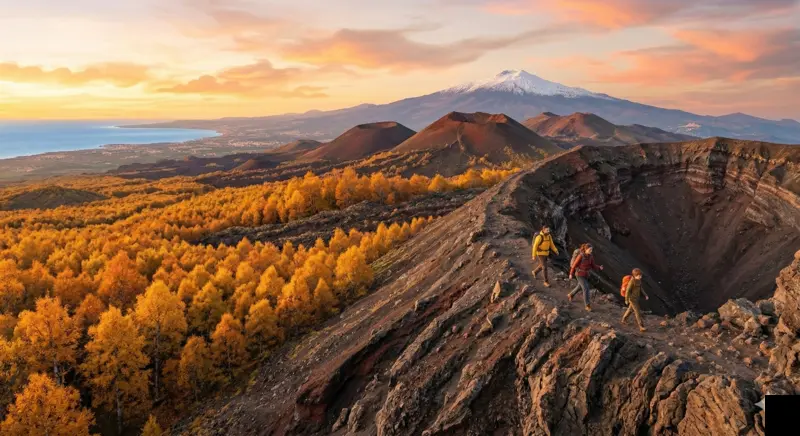
The north side of Mount Etna does not get the same foot traffic as the south. That works in its favour. Monti Sartorius sits at about 1,670 metres on the northeastern flank, inside the Etna Park, and it offers something rare for a volcano hike: an easy, well-defined loop through genuine volcanic terrain that does not require summit fitness or special permits.
This is not a consolation route for people who cannot handle higher trails. It is a different kind of Etna experience entirely. The Sartorius craters were formed during the 1865 lateral eruption, and the trail passes through a landscape that shifts from dark basalt lava fields to one of the densest Etna birch forests on the mountain. The contrast is sharp, and it is one of the few places on Etna where you can walk at a relaxed pace and still absorb the volcanic geology without rushing.
In our experience, many visitors arrive on Etna with a fixed idea: go as high as possible. That makes sense for some. But if you are travelling with children, prefer moderate physical effort, or simply want to understand how the volcano shapes its own landscape without the pressure of altitude and wind, Monti Sartorius is the strongest option on the north side.
This guide covers the trail in practical terms: what the terrain is really like, what you will see, how hard it actually is, and what most visitors underestimate before they arrive.
Quick answer
Monti Sartorius is an easy circular trail on the north side of Mount Etna, starting at around 1,670 m altitude. The loop takes roughly 2 to 2.5 hours, covers about 4 km with minimal elevation gain, and passes through the 1865 lateral craters, birch forest, and old lava fields. It is suitable for families, children from about 6 years old, and anyone who wants a genuine volcanic hike without high-altitude effort. No special permit is needed. A guided walk with a local volcanological guide adds geological context that is difficult to get from signs alone.
Where Monti Sartorius is located
The trailhead is on the north side of Etna, accessible from the road that connects Linguaglossa to Piano Provenzana. From Piano Provenzana itself, the drive is about 10 minutes south along a forest road. From Linguaglossa, the approach takes around 25 minutes by car.
This is not the side most tourists visit first. The south side — with Rifugio Sapienza, the cable car, and the 4x4 buses — draws most of the traffic. The north side is quieter, more forested, and operationally different. There are no cable cars or large-scale infrastructure. The trails here start lower and feel more immersed in the mountain environment.
GPS coordinates for the trailhead: approximately 37.79°N, 15.04°E. Mobile signal can be unreliable on some stretches, so download offline maps before arriving.
Why this area of Mount Etna matters
The 1865 eruption that created Monti Sartorius was a lateral event — magma broke through the flank rather than erupting from the summit. This left a chain of small cinder cones aligned along a fracture, and you can walk directly along their rims today. It is one of the clearest examples of a fissure eruption visible on foot anywhere on Etna.
What makes Sartorius geologically interesting is also what makes it visually striking. The craters are small enough to see their full shape from the rim. The lava flows are old enough to show early colonisation by lichens and pioneer vegetation, but recent enough that the basalt textures are still well-defined. This is volcanic succession on a human timescale — not millions of years, but about 160.
The Etna birch (Betula aetnensis) forest nearby is endemic to this volcano. It does not grow on any other mountain in the world. Walking through it is quiet, sheltered from wind, and a sharp contrast to the exposed lava terrain just minutes away. Mount Etna is a UNESCO World Heritage Site, and the Sartorius area is one of the zones where that designation feels most tangible.
What you actually see on the trail
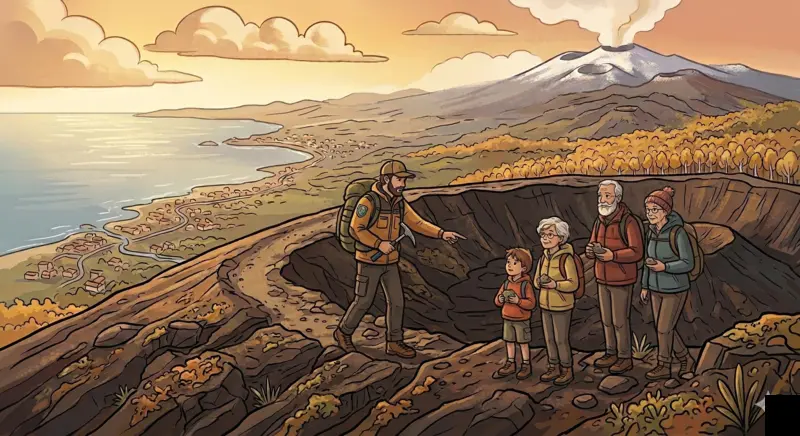
The trail is a loop. Most groups walk it counterclockwise, starting through the birch woods and then opening onto the crater area.
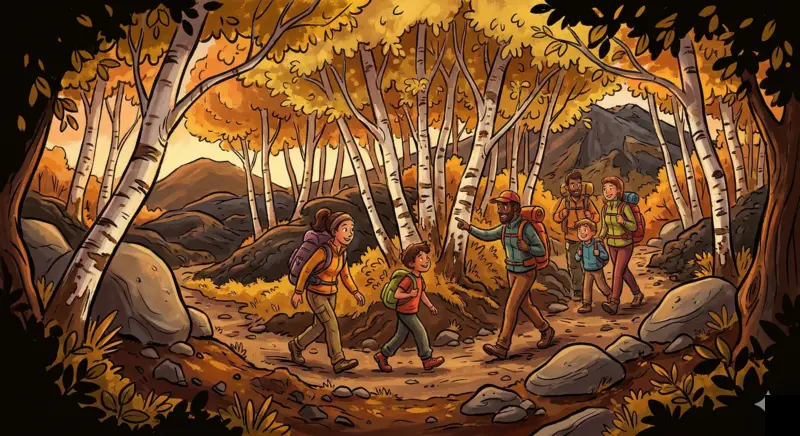
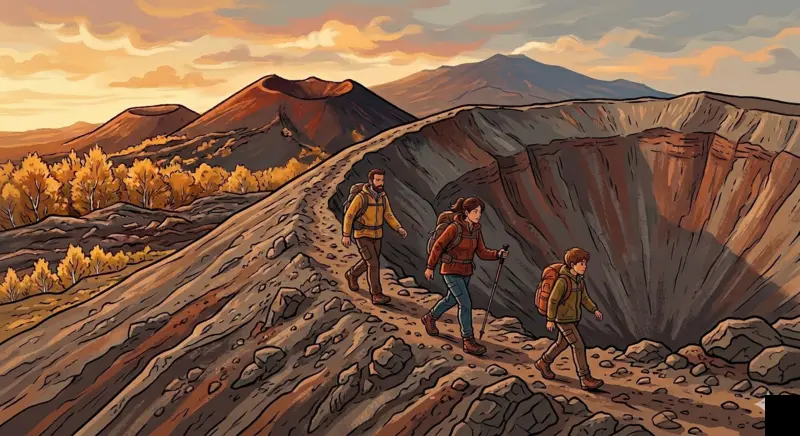
- Birch forest section: Shaded, quiet, soft ground underfoot. The trees are not tall — this is mountain birch adapted to volcanic soil and altitude. In autumn the foliage turns gold and the contrast against dark lava is particularly strong.
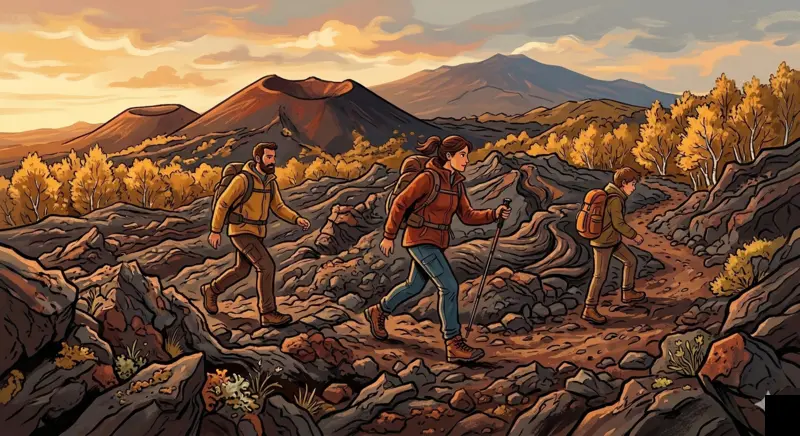
- Lava field crossing: The ground shifts to rough basalt. You walk on old aa and pahoehoe flows, and your guide can point out the difference in texture. Footing is stable but uneven. Ankle-supporting shoes help here.
- Crater rims: The 1865 cones are small, roughly 30 to 50 metres across. You can walk along the edge and look into the hollow interior. The geometry is clean — these are well-preserved volcanic features.
- Panoramic views: On clear days, the view extends northeast toward the Ionian coast and southeast toward the Valle del Bove. You can also see the summit craters from a distance, which provides a useful sense of scale for how large Etna actually is.
Trail conditions and difficulty
This is an easy hike by any standard. The total distance is about 4 km, the elevation gain is around 150 metres, and the trail is mostly well-marked. There are no exposed ridges, no scrambling, and no steep drops.
That said, the surface is volcanic. Parts of the trail cross rough lava with loose scoria underfoot. This is not pavement. Walking on volcanic gravel is slower and more tiring than it looks — your feet sink slightly with each step, and the ground surface is irregular. Many visitors underestimate this. Flat trainers or sandals are not adequate.
The trail does not require technical skills. A moderate level of general fitness is enough. If you can walk for two hours on uneven ground without difficulty, you will manage this route comfortably.
| Detail | Info |
|---|---|
| Difficulty | Easy |
| Duration | 2 – 2.5 hours |
| Distance | ~4 km (loop) |
| Starting altitude | ~1,670 m |
| Elevation gain | ~150 m |
| Starting point | Monti Sartorius trailhead, Etna North |
| Best season | May to November |
| Suitable for | Families, children (6+), seniors, beginners |
| Equipment | Hiking shoes, layers, water, sun protection |
| Guide required | Not mandatory, but strongly recommended |
Who this hike is for
Monti Sartorius works well for several profiles:
- Families with children: The distance and difficulty are manageable for children from about 6 years old. The craters give kids something concrete to look at and ask questions about, which keeps engagement higher than on a long uphill grind.
- Older visitors or mixed-fitness groups: The pace is flexible. There is no altitude pressure and no time-critical turnaround point.
- Nature-focused hikers: If you are interested in botany, geology, or ecology rather than summit endurance, this is the right trail.
- Visitors combining with other Etna activities: The 2.5-hour format leaves room to combine with a visit to Piano Provenzana or a different Etna excursion on the same day.
This is not the right route if you want a physical challenge. For that, consider the summit craters hike or the 2002 craters trek.
Best season and weather conditions
The trail is accessible from roughly May to November. In winter and early spring, snow can cover the area above 1,500 metres on the north side, making access impractical without snow equipment.
Summer (June through September) is the most reliable period. Days are long, the forest provides shade, and temperatures at 1,670 m are noticeably cooler than the coast — typically 8 to 12 °C lower than Catania. This makes Sartorius a good option on hot days when coastal heat makes lower hikes unpleasant.
Autumn is excellent. The birch trees change colour, the light is softer, and the area is very quiet. October is particularly good.
One thing to factor in: the north side of Etna is more exposed to clouds and moisture than the south. Morning fog can sit in the forest and lift by late morning. It is not a problem for the hike itself, but it affects photography and views. Check the Etna weather forecast before departure.
Safety considerations
Monti Sartorius is a low-risk hike, but it is still a volcanic environment. A few things to keep in mind:
- Footing: Lava rock is sharp and abrasive. A twisted ankle on rough basalt is the most common minor incident on Etna trails. Proper shoes reduce this risk significantly.
- Sun exposure: The crater area has no shade. At 1,670 m the UV intensity is higher than at sea level, and wind can mask how much sun you are getting. Bring sunscreen, hat, and sunglasses.
- Wind: The north side can be windy, especially in the open crater zone. Carry a windbreaker even in summer.
- Hydration: There are no water sources on the trail. Bring at least 1 litre per person.
- Mobile signal: Patchy. Do not rely on your phone for navigation. A guide or downloaded offline map is essential.
Volcanic activity is monitored by INGV. The Sartorius area is far from the summit vents and not subject to the same access restrictions that apply to higher altitudes.
Practical information
Getting there: Drive to the Monti Sartorius trailhead from Linguaglossa (about 25 min) or from Piano Provenzana (about 10 min south on forest road). There is a small parking area at the trailhead. No public transport reaches this point — a car or organised transfer is necessary.
Facilities: There are no services at the trailhead — no bar, no toilet, no shop. Bring everything you need. Piano Provenzana has a bar and parking facilities, so plan to stop there before or after.
Cost: The trail itself is free to access within the Etna Park. If you book a guided Sartorius walk, the guide fee covers geological interpretation, route management, and group pacing.
Duration: Allow 2 to 2.5 hours for the loop. With a guide, stops for explanation and observation are built in. Self-guided walkers may finish faster but miss most of the geological detail.
Expert insight
In our experience guiding on this trail, the most common mistake visitors make is treating Sartorius as filler — a backup plan when weather blocks higher routes. It is not. This trail has its own identity, and it rewards attention.
A few things we notice regularly:
- People wear the wrong shoes. The lava section is short but rough. Trainers with thin soles make it uncomfortable. Proper hiking shoes with ankle support make the difference between enjoying the walk and focusing on your feet.
- Visitors underestimate how cold the north side can get, even in summer. We have had June mornings at 8 °C with wind chill dropping it further. A fleece and windbreaker should always be in your pack.
- The geological features here are subtle. Without context, the craters look like small hills. With a guide explaining the eruption mechanics, the fissure alignment, and the lava flow chronology, the landscape reads completely differently.
- Photography is best in the morning or late afternoon. The midday sun flattens the lava textures and washes out the crater shapes. If you care about photos, time your visit accordingly.
- The birch forest is the quietest part of Etna. Seriously. On many days we are the only group in the area. That kind of solitude is hard to find on the south side.
Why visiting with a local guide makes a difference
You can walk Monti Sartorius without a guide. The path is marked and the risk is low. But there is a difference between walking through a volcanic landscape and understanding it.
A certified volcanological guide can explain why the craters are aligned the way they are, what the different lava textures mean, how the birch forest colonised the lava, and what the eruption of 1865 changed in this part of the mountain. These are things you will not find on trail signs or in a guidebook.
For families, a guide keeps the pace appropriate and turns the hike into an interactive experience rather than a simple walk. Children respond well to this format — they ask questions, they pick up rocks, they learn something concrete. A guided Sartorius walk is structured to allow this without rushing.
Frequently asked questions
Is the Monti Sartorius hike suitable for children?
Yes. Children from about 6 years old can manage the trail comfortably. The distance is short, the terrain is varied enough to keep them engaged, and the craters provide natural points of interest. Younger children may need to be carried on the rougher lava sections.
Do I need hiking boots for Monti Sartorius?
Proper hiking shoes with ankle support are strongly recommended. Parts of the trail cross rough lava rock where thin-soled shoes offer poor grip and no protection. Trail running shoes with good tread can work, but sandals and flat trainers are not suitable.
Can I visit Monti Sartorius without a guide?
Yes. The trail is within the Etna Park and does not require a guide for access. However, without geological context, the craters and lava formations are easy to walk past without understanding what you are looking at. A guide adds significant value to this specific hike.
What should I wear for this hike?
Layers. Even in summer, the north side of Etna at 1,670 m can be cool and windy. Bring a base layer, fleece, windbreaker, and sun protection. Long trousers are more comfortable than shorts on the lava sections.
How do I get to the Monti Sartorius trailhead?
By car from Linguaglossa (about 25 minutes) or from Piano Provenzana (about 10 minutes). There is no public transport. A small parking area is available at the trailhead.
Is Mount Etna safe in the Sartorius area?
The Sartorius craters are extinct lateral vents, far from the active summit. The area is not subject to the same volcanic access restrictions as higher zones. The main safety concerns are footing on rough lava, sun exposure, and wind — all manageable with basic preparation.
Can I combine Monti Sartorius with other Etna activities?
Yes. The 2.5-hour format leaves time for other activities. Many visitors combine it with a stop at Piano Provenzana, a drive through the Etna north forests, or a different guided Etna tour on the same day.
When is the best time to hike Monti Sartorius?
May to November, with the best conditions in June, September, and October. Summer offers the longest daylight and most stable weather. Autumn adds birch foliage colour. Winter snow usually closes the access road.
Before You Book: Quick Planning Checklist
- Check updated weather and volcanic activity conditions for your travel dates.
- Confirm meeting point, start time, and transfer duration.
- Request availability early for your preferred date and route.
- Read local safety guidance before excursions.